
Casting Lines of Hope: Healing & Recovery Through Fly Fishing
Healing doesn’t always happen in hospitals or therapy rooms. For many of us, it begins before dawn—driving miles to stand in a river, rod in hand, letting the therapeutic power of fly fishing work its magic. For me, the mental and physical weight of everyday life simply vanishes in the quiet rhythm of moving water. Fly fishing can be a sport, a hobby, or a form of therapy—a way to reconnect with something steady when life feels anything but.
Yet for a select few, it becomes far more: a lifeline, a bridge to a different life—one that once seemed unattainable.
Casting Lines of Hope captures the essence of Adam's Parachute, a heartfelt nonprofit founded by Jim Faust in loving memory of his son Adam. Drawing from the meditative power of fly fishing, Adam's Parachute offers free programs—including fly tying, casting lessons, day trips on the water, and overnight camping adventures—to individuals in recovery from addiction, their loved ones, and those in the high-stress world of addiction care. It’s more than an outing; it’s a lifeline rooted in mindfulness, nature, and connection—honoring Adam’s legacy of giving his “parachute” to save others.
In this post, I sat down with Jim Faust to better understand the story behind this transformative mission and the real impact it’s making, one cast at a time.
Before diving into our conversation, here’s a quick note on how I met Jim.
As a volunteer with RITU, my favorite part of chapter involvement—besides fishing with fellow members—is helping our group grow. That’s why I love attending social events like the Marlboro Fly Fishing Expo. Not only do I get to share our chapter’s mission and accomplishments with other anglers, but I also connect with inspiring people and organizations making a real difference in the fly-fishing world.
This year was no exception. As I wandered among the booths, Jim’s immediately caught my eye. I approached a friendly gentleman and asked him to tell me more about his organization. After just a brief conversation, a deep sense of gratitude filled my heart. I’d never met Adam or Jim before, yet I felt an instant connection to the cause of Adam's Parachute. We exchanged contact information, and soon after, we got together for this interview.
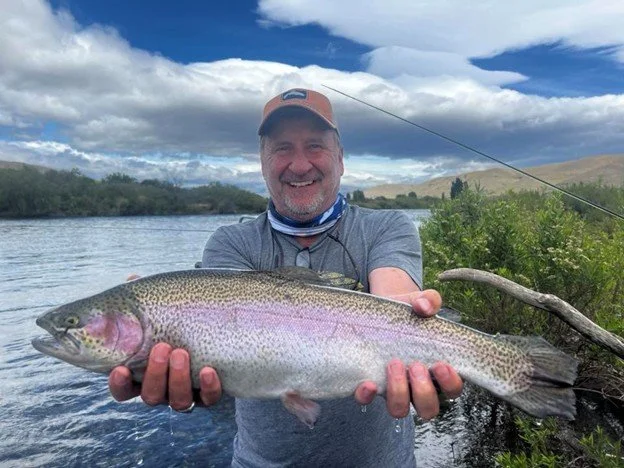
Jim Faust
1. Can you share more about Adam's journey? How did his addiction begin? How did his recovery look like?
Our Adam, like many people struggling with drug addiction, became addicted to painkillers following multiple surgeries in his early teens. At the time, it was common practice to treat post-operative and chronic pain with what would now be considered very high and unacceptable doses of opioids, and the medical community did not yet fully recognize how powerfully addictive these medications could be.
Adam’s addiction deepened when he went away to college. In the years following Adam’s college graduation, we still did not realize that he had developed a serious drug problem. Slowly, things unraveled. After countless negative drug tests at home (we did not know, for example, that fentanyl was not detected by many home tests), many heart-to-heart conversations, and all the other things families go through when a child is addicted to drugs, Adam eventually agreed to go to a rehab facility. It was there that we learned he had become addicted to fentanyl.
Adam finished a 30-day inpatient program, came home and attended outpatient therapy for several months. He seemed to be doing well, but after six months he relapsed and sought help immediately. He went back into treatment and this time, through detox, partial hospitalization programs, outpatient therapy, and sober living, his recovery really seemed “to stick.”
Adam was living at home, and it was at this time that he found his passion for helping others who suffered as he did with drug addiction. He worked very hard, first as a case manager and then as a business development officer, at recovery programs in the greater Boston area. He often worked 80 to 100 hours a week. We told him frequently that he needed more balance in his life and that he couldn’t help everyone. But his response was always, “I can’t help everyone, but I can help everyone who crosses my path, and that is what I’m going to do.”
Adam was in recovery for two years and two months when he passed away from fentanyl poisoning. Just the night before, he saved the life of a client of his, a young man who had overdosed.
I told Adam many times that I did not regret what he endured or what our family went through, because the man who emerged from that hellish journey was one of the greatest, kindest, and most dedicated people I have ever known. Adam’s recovery didn’t just change his life, enabling the loving, caring, empathetic, smart and funny son and brother to re-emerge—it also allowed him to positively influence the lives of so many others.
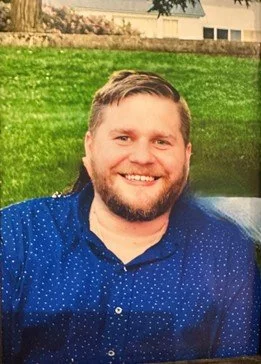
In loving memory of Adam
2. After such profound loss, what gave you the strength/determination to channel your grief into founding this non-profit rather than shutting yourself off from the outside world?
Truly, our lives as we knew them ended when Adam passed. Simply living felt impossible. We relied heavily on family and a small number of friends to survive those first few weeks.
I also fished a lot, late at night, a half mile into the woods on a local river, by myself, trying to regain some strength. In the pitch black, I would focus on feeling the weighted fly line load and unload, listening for rises and nearby wildlife, concentrating on the gentle tug of a bite. Fishing put my mind in the present moment, because the near past was impossible to look at and the future—even just a few days—seemed impossible to fathom.
One night, about six weeks after Adam passed, I was fishing and around midnight I headed back out of the woods. I stopped in a field that opened up to reveal stars, reminding me of the shooting star Adam had tattooed on his forearm. That night I felt as close to reaching my end as I ever had. I could not see a path forward to continued life without my boy. I begged Adam and Jesus for some comfort. As I often did, I yelled Adam’s name once, as loud and as long as I could, and listened for the echo. I walked the rest of the way out of the woods to my truck, crying and exhausted, physically and emotionally.
That night I dreamed “Adam’s Parachute.” I woke up wondering why? Then I realized that this was the comfort I begged for. Yes, Adam’s Parachute is a common and successful fly that imitates mayflies, but also, Adam literally gave his parachute to someone else the night before he passed. Then and there I decided to throw my whole being into bringing the therapeutic benefits of fly fishing to those seeking recovery from substance use disorder.
Today, my strength comes from knowing that Adam is in front of me, not behind me. He is cheering me on. He is with me every step of the way. And although this transient separation from him will be the hardest thing I face in my lifetime, I hold firmly to my belief that we will be together again by God’s grace.
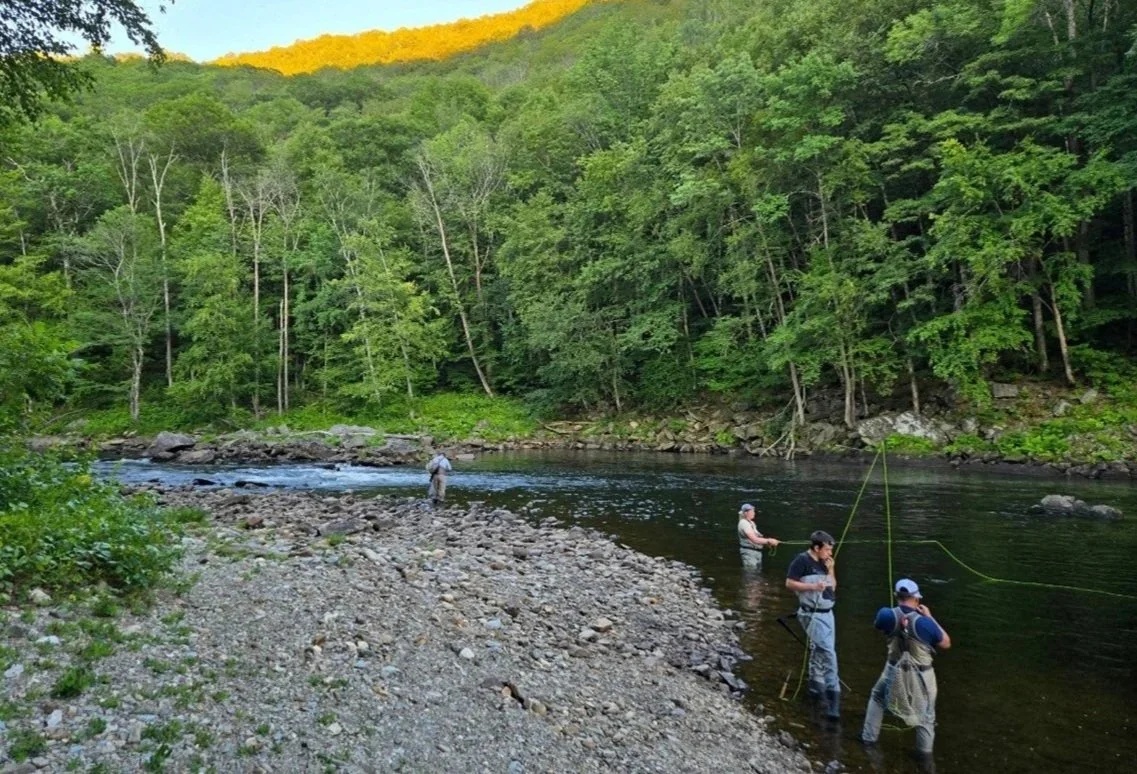
3. Why Fly Fishing? What makes Fly Fishing more therapeutic than other means of recovery?
After my retirement and before Adam’s passing, I volunteered with Project Healing Waters, a non-profit that brings the benefits of fly fishing to active military members and veterans. That experience helped me see how fly fishing could offer profound healing. Research has shown that fly fishing can decrease depression, anxiety, and PTSD, and improve sleep quality. But just as importantly, it teaches people how to live in the present moment—and that is critical for people in recovery from addiction.
In fly fishing, you look upstream—that’s the future. You look downstream—that’s the past. But the only place you can actually catch a fish is right here, right now. When you are fully focused on the water in front of you—your cast, the current, the drift—your mind quiets and you become present. For many people in recovery, learning to live one moment at a time can make all the difference. Yet, when I looked for programs bringing fly fishing specifically to people in recovery from addiction, I found none. That gap helped inspire me to start Adam’s Parachute.
I believe the benefits of fly fishing apply to anyone who struggles, whether that struggle is substance use disorder, chronic illness, behavioral health challenges, grief, or something else. Struggle is a universal human experience—it connects us. It is why, even though I am not in recovery myself, I can help those who are seeking it. And they can—and do—help me in return.
Many of the people I meet in recovery have reached the lowest point in their lives and are trying to stand back up. In my own way, I am doing the same. They cannot do it alone; neither can I. We face our individual battle every day.
Every time I meet with recovery warriors, I ask Adam to help me help just one person—he was so very good at that. Over time, I discovered something remarkable: one person is always helped. And that person is me.
In my work with Adam’s Parachute, I am reminded often of a quote from Ram Dass, the spiritual teacher and author: “We are all just walking each other home.”
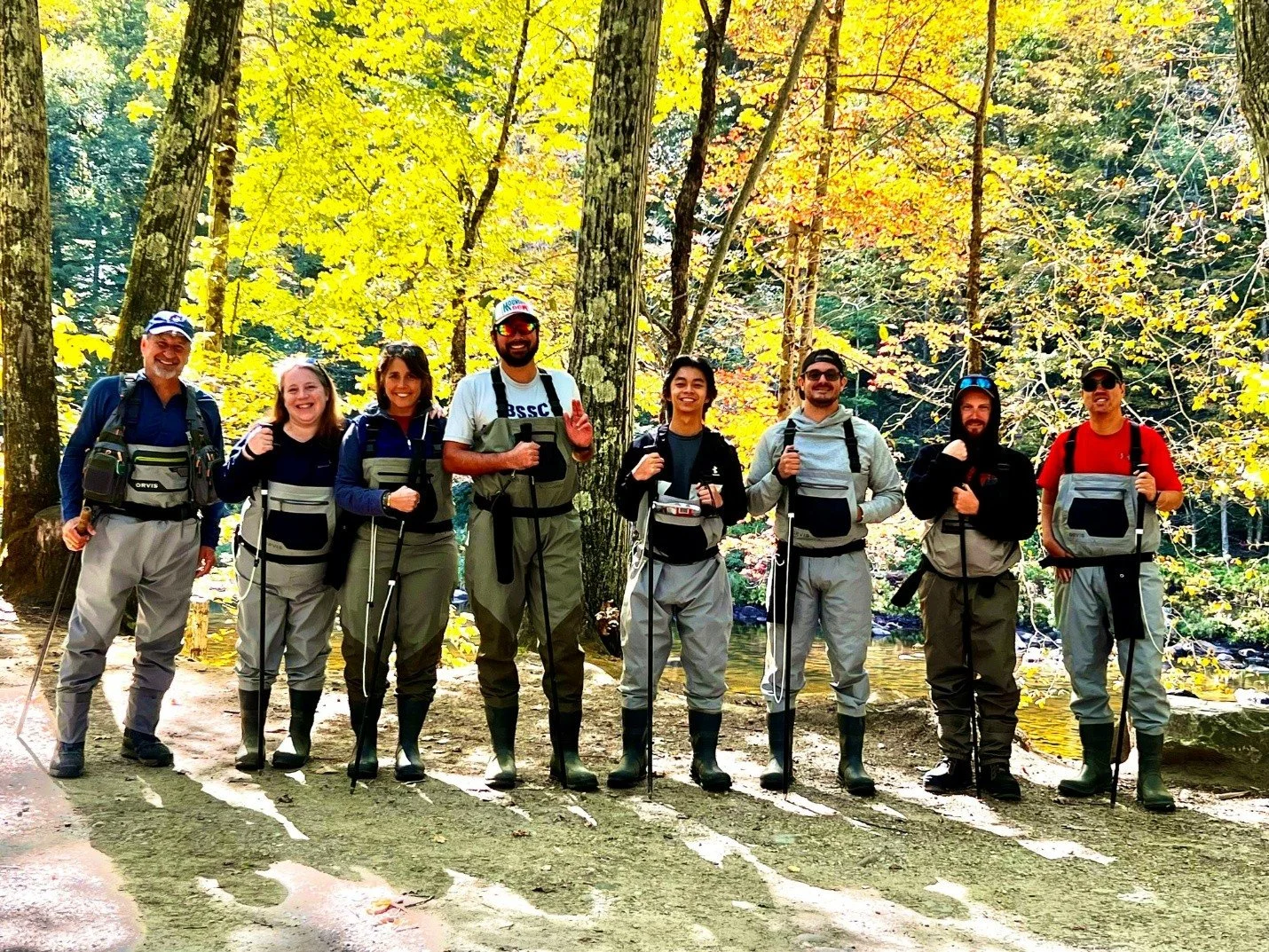
4. You have worked with dozens of people and turned their entire lives around. How do these people find inner peace or willingness to fight through fly fishing? Can you share any particular moving moments?
Adam’s Parachute offers a range of free fly fishing programs to clients in recovery from addiction, from fly-tying and casting classes to day trips and even overnight camping excursions. We partner with recovery centers, sober homes, clinics, schools, and community organizations. Last year was our first full year up and running, and we introduced hundreds of clients to fly fishing and taught fly tying and casting to many more.
Through our programs, I’ve fished up to 10 times with a few clients and developed real friendships with many. Some have told me that looking forward to an upcoming fishing trip kept them sober. Others have said that learning to tie a fly has been the single most enjoyable part of their recovery experience. People have hugged me and told me they knew my Adam and that he saved their lives. I walk into recovery programs for return visits and am greeted with, “Hey, Jim’s here, the fly fishing guy!”
I have taught people who are still in detox how to tie a fly. They focus and they love it, and for some, for the first time in a long while, the chaos of life quiets down. When they tell me that, I say, “Wait ‘till I get you out fishing!!”
These moments are what make Adam’s Parachute so powerful. It offers unwavering respect and support to people taking on the battle of drug addiction. It is critical that those suffering understand they are not alone. I am so proud to meet and shake hands with every single person I meet on this path. They are brave, honest, and incredible. They are the best of the best in all the human ways that matter.
Seeing them gain confidence, joy, and hope through fly fishing is the greatest reward and the true measure of Adam’s Parachute’s work.
5. What has been some of the biggest challenges in launching and growing Adam's Parachute? Where would you like your organization to be 5 years from now? And lastly, for someone reading this that might be going through recovery, or trying to recover from the loss of a loved one, what message would you want them to hear from you?
Building a nonprofit that is true to its mission and grows sustainably takes a lot of work. I am fortunate to have the help of family and friends, each bringing expertise I do not have, helping us meet the legal, business, and logistical challenges of reaching as many people in recovery as possible.
In our first year, we stayed afloat thanks to donations from family and friends. In year two, with the help of Anevry, a terrific company that supports nonprofits, we have made major strides with website upgrades, marketing, and grant writing. We were also fortunate to have a booth at The Fly Fishing Show in Marlborough this past January, which helped us make connections that are extending our reach to more recovery warriors.
Our biggest challenges remain funding—since our programs are completely free—and recruiting enough volunteers. I currently teach about 150–200 fly tiers each month, and this season we plan to get 250 new fly anglers on the water. Adam’s Parachute has now crossed paths with over 1,200 people seeking long-term recovery, introduced 100 new anglers to the water last year, and taught nearly 500 fly tiers during our first winter. This winter we expect to exceed 850 fly tiers. We visit programs throughout Massachusetts, and in five years, I hope to expand Adam’s Parachute to at least two additional states.
We can’t help everyone, but as Adam said, “We can help everyone who crosses our path.” We are determined to cross tens of thousands of paths in the years to come.
To anyone reading this who is struggling with substance use disorder or trying to recover from the loss of a loved one: you are not alone. Help with addiction is only a phone call away. You are stronger than you think. You matter so much. No matter what your past, your future is spotless. And if you want to experience the healing benefits of fly fishing, Adam’s Parachute is here for you!
As our back and forth ended, Jim shared a quiet truth that will stay with me forever: in fly fishing, you look upstream to the future and downstream to the past, but the fish—and the healing—only happen right here, in the present moment. Adam’s Parachute embodies that truth. What began as a father's unimaginable grief has become a beacon of hope, proving that even in the deepest darkness, a single cast can pull someone back to shore. Adam didn't just find recovery—he gave his parachute away, time and again, so others could keep going. Now, through Jim's unwavering dedication, that parachute is unfolding for hundreds more: a quiet river, a steady line, a moment of peace where chaos once reigned.
If Adam's story, or the simple power of standing in moving water, touches you—whether you're in recovery, supporting someone who is, grieving a loss, or just seeking your own calm—know this: you're not alone. Help is waiting, often just a phone call or a step into the current away. Visit adamsparachute.org to learn more, donate, volunteer, or sign up for a program. Because hope isn't something we wait to catch—it's something we cast out, together, one mindful line at a time. In Adam's name, and in the name of every recovery warrior still fighting, let's keep casting.